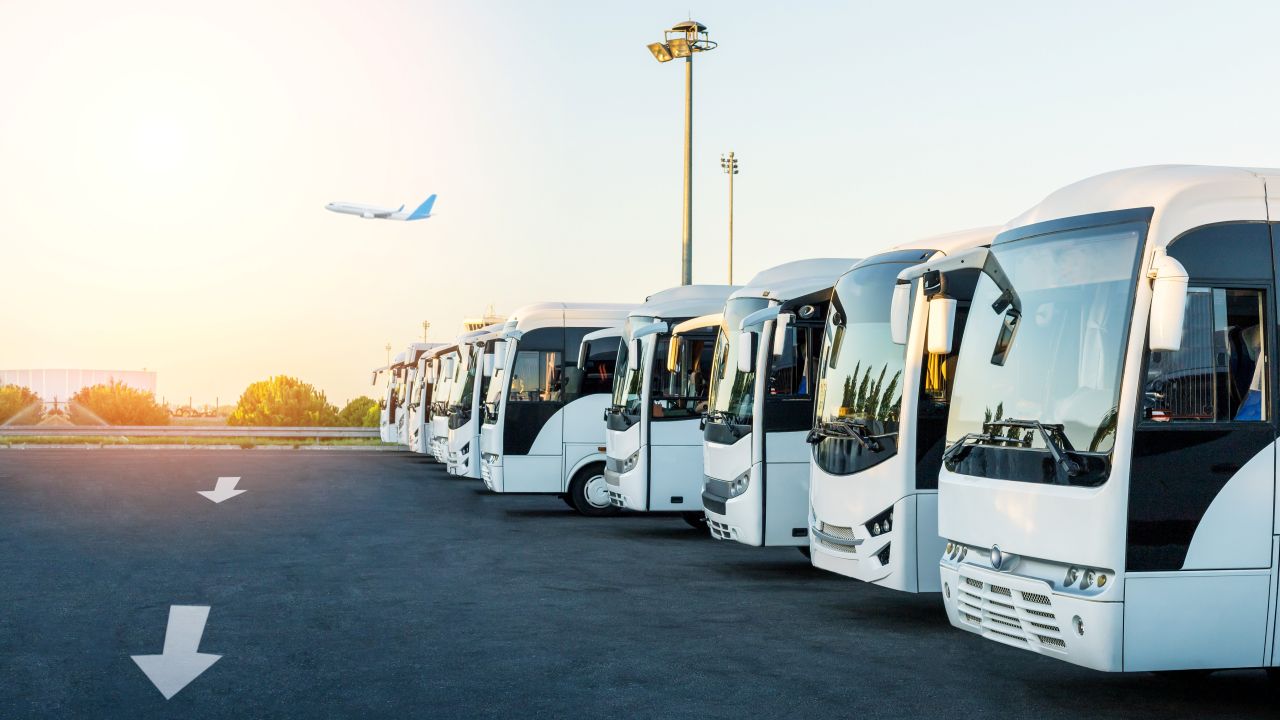
An airport-to-airport shuttle service will enable passengers with multiple destinations to connect to their next flight easily. Photo credit: iStock/Sergei Chuyko.
A working air–land transport integration model may later be scaled to include sea transport.
The private sector in BIMP-EAGA is supporting an initiative to make direct transfers between Brunei International Airport and Miri International Airport in Sarawak, Malaysia feasible. This will enable passengers with multiple destinations to connect to their next flight easily.
“The initiative reflects ongoing private sector coordination in alignment with the established regulatory and policy processes of participating authorities,” said Thomas Koh, who chairs the BIMP-EAGA Transport Private Sector Alliance. Koh is the country director of BIMP-EAGA Business Council (BEBC) Brunei Darussalam.
The airport-to-airport linkage by land would demonstrate “how existing policy arrangements and infrastructure assets can be mobilized to support corridor-level multimodal integration,” according to a report on the initiative. A working air–land transport integration model may later be scaled to include sea transport.
Proposed in July last year, the initiative was identified as a priority project of the BIMP-EAGA Transport Cluster.
Transport hub and logistics corridor
The two international airports are important gateways in BIMP-EAGA’s West Economic Corridor, which is envisioned as a transport hub and logistics corridor. Miri also serves domestic flights to key tourism destinations within Sarawak and other domestic routes.
Land travel between the airports via the Muara–Tutong Highway is a 163-kilometer journey that takes more than 2 hours. At present, there are limited coordinated ground transportation services that link the two airports and that connects them with regional and local destinations.
The initiative seeks to provide structured point-to-point cross-border coach and bus services, using existing airport, road, and border infrastructure. This is expected to strengthen air–land transport integration, consolidate passenger flows across borders and improve route sustainability, expand airport catchment areas on both sides, and enhance the development impact of the West Economic Corridor.
Existing frameworks and arrangements
The planned airport-to-airport linkage uses existing cross-border frameworks and regulatory coordination.
The Memorandum of Understanding (MOU) on Cross-Border Movement of Commercial Buses and Coaches, which was signed by Brunei Darussalam, Indonesia, Malaysia, and the Philippines in 2007, facilitates cross-border transport through commercial buses and coaches on selected routes.
Meanwhile, the Border Management Facilitation and Travel Program has helped streamline immigration procedures between Brunei Darussalam and Malaysia. It eliminated the need for multiple stamping of passports at key border crossings, including at Sungai Tujoh immigration checkpoints at the Belait District of Brunei Darussalam and Miri in Sarawak.
Status of implementation
The report noted that there is ongoing coordination with transport and tourism authorities in both Brunei Darussalam and Sarawak, Malaysia to further develop and explore the proposed multimodal connectivity initiative.
Miri Transport Company and Anthony Tours & Travel have signed an MOU on 23 September 2025 to jointly provide direct airport-to-airport coach services from Miri and have completed the procurement of new coaches in preparation for the implementation of the initiative. On the Brunei Darussalam side, existing coaches may be used as part of the proposed arrangement.
Discussions with airline operators and other stakeholders continue on feeder alignment, scheduling coordination, designated pickup and drop-off points, and other operational matters.
Expected outcomes and benefits
The multimodal transport integration initiative is expected to improve passenger load optimization and route sustainability without requiring additional capital investment.
“This initiative serves as a practical testbed for multimodal coordination within BIMP-EAGA. It demonstrates structured air–land integration, scheduled cross-border passenger management, corridor-based traffic coordination, and operational proof-of-concept for multimodal transport planning,” the report said. It also lays the foundation for the potential “integration with maritime connectivity, enabling eventual air–land–sea scheduling alignment.”
The initiative is also expected to boost tourism and business travel by improving passenger access and mobility, opening opportunities for marketing Brunei Darussalam and Northern Sarawak as dual destinations, encouraging business tourism and short stays, and enhancing confidence in cross-border travel.