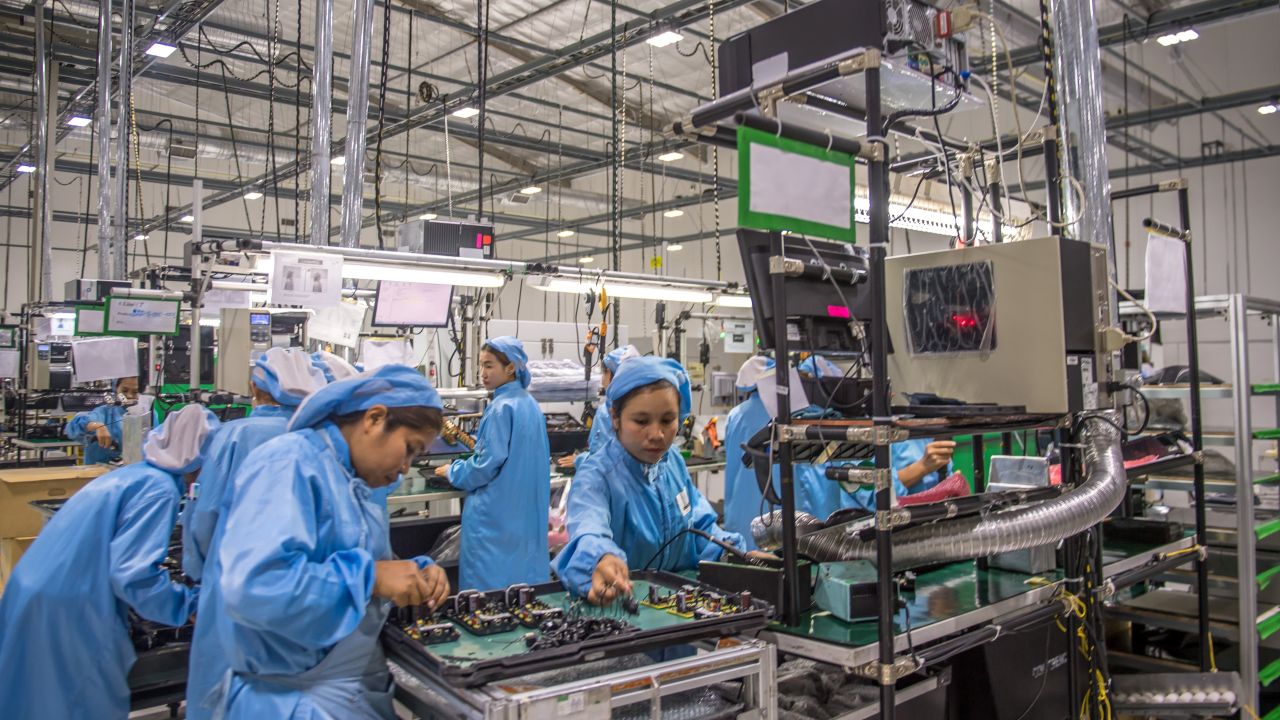
An electronics factory at a special economic zone in Southeast Asia. Photo credit: Asian Development Bank.
Foreign direct investment in supply-chain intensive industries and special economic zones continues to increase.
Foreign direct investment (FDI) continues to drive supply chain development in Southeast Asia. It has played a key role in transforming the region into a major hub of manufacturing, financial services, and innovation.
According to the ASEAN Investment Report 2025, FDI inflows in the ASEAN region rose by 8% to $226 billion in 2024. The region continued to buck the worldwide downtrend in inflows, accounting for a 15% share of the global total and retaining its position as the leading recipient of FDI among developing regions.
Factors behind the continued increase include the global wave of supply chain restructuring triggered by trade tensions, opportunities from deeper regional economic integration, “growing investor interest in manufacturing, and strategic investment by international companies to strengthen supply chains in key industries, such as electronics, electric vehicles (EVs), pharmaceuticals, and the digital economy.”
“FDI continues to play an instrumental role in driving ASEAN’s supply-chain intensive sectors, including textiles, automotive, semiconductors, and the digital economy,” notes Secretary-General Kao Kim Hourn of ASEAN in the report’s foreword.
Strengthening the ecosystem
FDI and other activities of multinational enterprises boost the ASEAN’s supply chain development in three ways:
- financing enabling infrastructure and services, such as logistics, special economic zones (SEZs), digital infrastructure, and energy supply;
- expanding supply-chain intensive industries; and
- building the broader supply chain ecosystem, which includes small and medium-sized enterprises (SMEs) and supplier networks.
The report notes continued investor interest in SEZs “with announced greenfield investment rising from an annual average of $9 billion in 2015–2018 to $13 billion in 2021–2024.” Meanwhile, greenfield investment in supply chain-intensive sectors, such as electronics, automotive, and apparel, increased by 20% to $41 billion in 2024 from 2021.
In contrast, FDI in transport services, logistics, and warehousing is declining, while internationally financed infrastructure and renewable energy investment, which are needed to achieve the Sustainable Development Goals (SDGs), dropped by two thirds.
“To sustain smooth supply chain operations and foster a robust FDI environment, ASEAN must address critical constraints, including the availability of skilled labor, infrastructure and logistics capacity, port congestion, access to trade finance, and mutual recognition of standards and certifications,” says Kao. “Coordinated regional efforts are essential for strengthening the region’s competitiveness as a global supply chain hub.”
In 2024, ASEAN developed a regional framework to improve supply chain efficiency and resilience. This includes enhancing trade and investment facilitation, diversifying markets and suppliers, improving risk management, embedding ESG (environment, social, and governance) standards, and supporting SME growth.
In the BIMP-EAGA subregion, plans are under way to integrate SEZs into economic corridor development to support cross-border value chain development and create employment and business opportunities, particularly for SMEs.
Rising uncertainty
The report underscores “ASEAN’s strong role in global value chains (GVCs), but also its dependence on international markets and production networks and its vulnerability to supply chain shocks.” It cites that the region contributed about 3% to global GDP in 2020–2023, while its shares of merchandise exports and FDI inflows were more than 9% and 14%.
Renewed trade tensions and rising economic and policy uncertainty have disrupted global value chains in 2025 and are affecting investment sentiment.
These developments are “likely to exert a considerable influence on firms to recalibrate their international investment and production activities. ASEAN may need to make a greater regional effort to attract and facilitate FDI, including enhancing supply chain ecosystems and channeling investment to SDG-relevant sectors, such as infrastructure, energy and digital development,” says the report.
Recommendations
To improve the resilience of supply chains against shocks, the report identifies the following priority areas for policy action:
- strengthen ties with dialogue partners and deepen regional economic alliances and partnerships, such as the Regional Comprehensive Economic Partnership (RCEP);
- promote investment in sustainable sectors, including regional supply chains for renewables and electric vehicles;
- create backward and forward linkages by partnering with SEZ and industrial park developers and anchor investors and to support SME growth around industrial clusters;
- enhance cooperation and improve interconnectivity between industrial parks;
- promote FDI in green and tech-ready SEZs;
- encourage supply chains to adopt circular economy principles;
- support research and development and innovation, particularly for critical sectors, such as semiconductors, pharmaceuticals, and food; and
- put in place regional cyber-resilience and data protection measures for supply chain continuity.